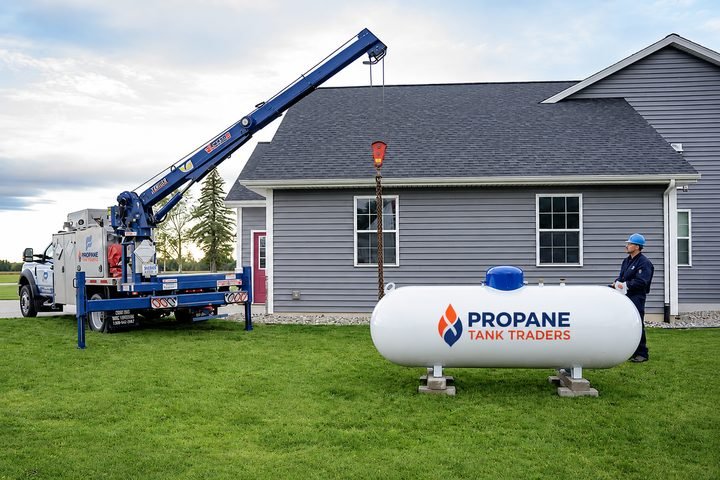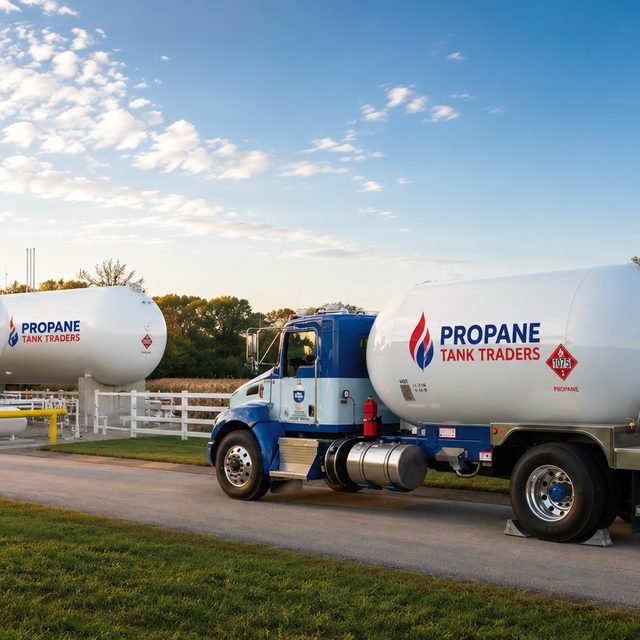
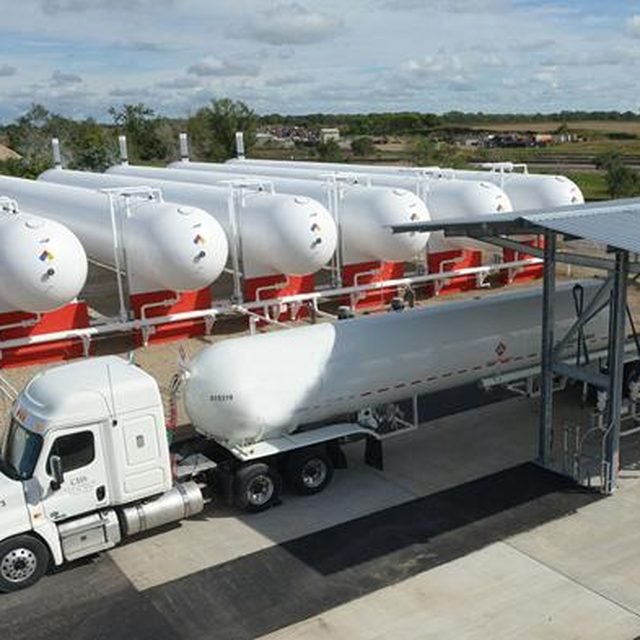
Propane tank purchase prices currently run from $199 for a 100 lb cylinder to $35,000 for a bulk skid tank, with the common 500 gallon residential size listed at $820 used to $2,420 new underground, plus $350 flat freight. The tank is often less than half the total: site prep, gas line, permits, and the first fill add substantially, and those costs are entirely local. Get quotes from licensed propane professionals in your area, and expect ownership to beat renting somewhere around year five to seven.
How much does a propane tank cost is a question with two answers: the price on the tag, and the number you actually write checks for. Those figures can differ by a factor of two, and the gap is where most buyers get surprised.
A tank is a steel pressure vessel. Its price tracks steel, wall gauge, ASME certification, and whether it has been in service before. Everything after that – freight, a pad, a gas line, permits, the first fill – is site work, and site work varies enormously by jurisdiction.
This guide separates the two. Purchase pricing below is current listed pricing from our store. Installation figures are given as ranges you should treat as a starting point for local quotes, not as estimates you can budget against.
How much does a propane tank cost by size?
Here is the current listed price range for each size we stock. Ranges are wide because they span used, refurbished, and new units, and because underground tanks carry a premium over above-ground equivalents of the same capacity.
| Tank size | Current listed price range | Notes |
|---|---|---|
| 100 lb / 24 gal cylinder | $199 – $766 | DOT cylinder; portable |
| 200 lb / 45.6 gal | $650 – $1,400 | DOT cylinder |
| 120 gal (420 lb) | $741 – $1,450 | ASME; vertical, slab-mounted |
| 250 gal | $650 used – $2,350 new | Widest used-vs-new spread |
| 320-330 gal | $1,092 – $2,950 | Partial home service |
| 500 gal | $820 used – $2,420 new underground | Most common residential size |
| 1,000 gal | $950 scrapped – $5,300 new underground | Cold-climate homes, small farms |
| 1,500 gal | $2,600 – $2,950 | Agricultural, light commercial |
| 2,000 gal | ~$3,705 | Commercial |
| 2,500 gal | ~$6,100 | Commercial process heat |
| 10,000 gal | ~$13,300 | Bulk storage |
| 18,000-30,000 gal | $28,000 – $35,000 | Skid or bullet installation |
Freight is separate: a flat $350 per order within the contiguous U.S., with Alaska and Hawaii quoted individually. That flat rate is worth noting when you are deciding between sizes, because a 1,000 gallon tank ships for the same freight as a 250. Full terms are in our shipping policy.
Propane tank prices move with the steel market and with inventory, so treat any range you read as a snapshot. Current pricing on every size is on the shop page.
New versus used propane tank cost
The used market is where the biggest savings live and also where the biggest mistakes happen. A used 500 gallon tank at $820 against a new one at over $2,000 is a meaningful difference, and for many buyers a sound used tank is the right call.
What separates a good used tank from a bad one is documentation and condition. Look for a legible ASME data plate, no pitting or scaling under the paint, intact valves and a working gauge, and a verifiable service history. A tank whose data plate is unreadable is difficult to place into service, because the installer cannot confirm its design pressure or manufacture date.
Stationary tanks are built to the ASME Boiler and Pressure Vessel Code, Section VIII. Unlike DOT cylinders, which require periodic requalification under 49 CFR Part 180, ASME tanks have no fixed expiration date. They are inspected in place and remain in service as long as they pass. That is why a well-maintained 20-year-old ASME tank can be a reasonable buy while a 20-year-old cylinder with an expired stamp is not.
We cover the inspection checklist in more detail in our comparison of new versus used propane tanks.
Above ground versus underground propane tank cost
Underground tanks cost more twice over: the tank itself and the work to bury it.
The tank costs more because it is coated for burial. Underground units get a factory-applied epoxy or coal-tar coating and ship with a sacrificial anode bag for cathodic protection, which slows corrosion by giving the soil something more reactive than the tank to attack. Anode bags are consumable and get checked and replaced on a maintenance cycle.
The installation costs more because of excavation. A 500 or 1,000 gallon tank needs a hole sized with clearance for backfill, a stable base, and in high-water-table areas an anchoring system to keep the tank from floating. You also need a riser and a dome that sit at grade to house the valves and gauge.
Excavation cost depends on your soil, your access, and your local contractor market. Rock is expensive. A tight backyard that a mini-excavator cannot reach is expensive. There is no national figure that means anything here, which is why we tell buyers to get two or three local quotes rather than budget from an internet number. Get two or three local quotes before you assume burial is out of reach.
How much does a propane tank cost to install and own?
The tank is often less than half of what you spend to get propane flowing. Here is what else is on the list.
- Freight: $350 flat per order in the contiguous U.S. This one is fixed and known.
- Site prep: a level concrete pad or compacted gravel base for above-ground tanks; excavation, backfill, and possible anchoring for underground. Costs range from modest to significant depending on soil and access.
- Gas line and regulator: underground yard line from tank to house, first- and second-stage regulators, and a pressure test. Priced by linear foot and by trenching difficulty.
- Permits and inspection: most jurisdictions require a permit for a stationary propane installation, and the authority having jurisdiction inspects before the system is commissioned. Fees vary widely by county.
- First fill: at 80 percent of capacity, a 500 gallon tank takes roughly 400 gallons. At typical retail propane prices this is frequently one of the larger line items on the whole project.
Two of those deserve emphasis. First, the first fill regularly surprises people – 400 gallons of propane is real money, and it recurs. Second, installation of a stationary tank and any gas piping is licensed work almost everywhere. This is not homeowner DIY, and the separation distances involved are set by NFPA 58, the Liquefied Petroleum Gas Code, not by preference.
We will not quote you an installation number, because a figure that is honest in rural Arkansas is badly wrong in coastal California. Get local quotes. Any supplier who gives you a precise national installation price is guessing.
Buy versus rent over 5 to 10 years
Renting a tank from your propane dealer usually means little or no upfront cost, free maintenance, and a per-gallon fuel price set by that dealer. Buying means paying for the tank once and then being free to shop fuel.
The economics turn on two things: annual rental fees and the price spread between a captive rate and a competitive one. When you rent, you generally cannot buy propane from anyone but the tank’s owner, which removes your leverage.
How the math tends to run
- Years 1-2: renting is clearly cheaper. You avoided the tank purchase and the freight.
- Years 3-5: the lines converge. Accumulated rental fees plus any per-gallon premium start to approach the purchase price.
- Years 6-10: ownership is generally ahead, and the gap widens each year. You still own an asset with residual value.
The crossover point moves with your usage. A household burning 1,200 gallons a year hits it much sooner than a cabin burning 200, because the per-gallon spread is where most of the advantage accumulates. Run the numbers with your own consumption using our buy versus rent breakdown.
One caveat worth stating plainly: some dealers will not fill customer-owned tanks, or charge more to do so. Confirm that your local suppliers will service an owned tank before you buy one.
What drives the price up or down
Beyond capacity, four factors explain most of what makes one propane tank cost more than another, and they explain most of the variation you will see between two tanks of the same size.
Steel prices. A propane tank is mostly steel by cost. When hot-rolled coil moves, tank prices follow within a quarter or two. This is the main reason listed ranges shift over time.
Wall gauge and design pressure. Heavier plate costs more and weighs more, which affects handling on your end. Underground tanks and higher-pressure designs use thicker steel.
Certification and documentation. A tank with a clean ASME data plate, current inspection, and traceable history is worth more than an identical tank without paperwork, because the second one may be difficult to commission.
Condition and refurbishment level. Between “used” and “new” sits a range: sandblasted and repainted, new valve trim, replaced gauge. Each step adds cost and reduces risk.
We source from Quality Steel Corp, Manchester Tank, and Newberry.
Cost per gallon of storage
One way to sanity-check propane tank prices across sizes is to divide the price by usable capacity. Because tanks fill to 80 percent, a 500 gallon tank stores about 400 usable gallons and a 1,000 gallon tank about 800.
Run that division and the pattern is consistent: the propane tank cost per usable gallon falls as capacity rises. A 120 gallon tank near the top of its range works out to well over $10 per usable gallon of storage. A 1,000 gallon tank in the middle of its range lands in the low single digits. A 2,500 gallon tank is lower still.
That does not mean you should buy the largest tank you can afford. An oversized tank holds fuel longer between turnovers, occupies more of your lot, and faces larger NFPA 58 setback requirements. But if you are genuinely torn between two adjacent sizes, the cost per gallon of storage plus the flat $350 freight usually argues for the larger one.
Financing and returns
Monthly payment plans are available for qualified buyers, which matters most on the 1,000 gallon and larger sizes where the purchase is a genuine capital expense. Ask about terms when you call rather than assuming a size is out of reach.
Orders ship to all 50 states in 3 to 10 business days depending on size and destination. There is a 30-day return guarantee; a 15 percent restocking fee applies to non-defective returns of tanks 500 gallons and above, which reflects the freight and handling on a unit that size. The full terms are in our return and refund policy.
The bottom line
How much does a propane tank cost depends on size, condition, and whether it is going above or below grade – roughly $199 for a 100 lb cylinder up to $35,000 for a bulk skid tank, with the common 500 gallon residential size running $820 used to $2,420 new underground. Add $350 flat freight.
What you cannot budget from an article is installation. Site prep, gas line, permits, and the first fill can rival or exceed the tank price, and they are entirely local. Get quotes from two or three licensed propane professionals in your area before you commit.
If you want help matching a size to your actual load, start with our tank sizing guide, then call (501) 218-9328 or email sales@propanetanktraders.com. Hours are Mon-Fri 9am-6pm CST and Sat 9am-3pm CST.