Installing a propane tank is a licensed job: connecting gas piping, setting regulators, pressure testing, purging, and the first fill must be done by a licensed professional under NFPA 58 and your local AHJ. Your job is the site work - separation distances, permits, calling 811, delivery truck access, and a level pad or properly bedded excavation. This guide covers the typical NFPA 58 distance table, what the installer does, and the sign-off paperwork to keep.
If you are researching how to install a propane tank at your home or facility, the first thing to understand is that the connection and commissioning work is not a homeowner project. In essentially every U.S. jurisdiction, tying a tank into gas piping, setting the regulator, pressure testing, purging, and making the first fill legally requires a licensed propane professional or licensed gas fitter.
That is not a liability disclaimer we are hiding behind. It is how the code is written. NFPA 58, the Liquefied Petroleum Gas Code, governs container siting, installation, and filling, and your local authority having jurisdiction (AHJ) enforces it alongside state licensing rules and local amendments.
What you can and should do is everything that happens before the installer arrives: choosing a legal, workable location, pulling permits, clearing truck access, and preparing a proper base or excavation. Done well, that work is most of the project. Done badly, it is the reason an installer refuses the job or an inspector fails it. This guide walks through both halves so you know what you are responsible for and what you are paying a professional to handle.
How to Install a Propane Tank: Why This Is a Licensed Job
A propane system stores liquid under pressure and delivers vapor at a few tenths of a PSI to appliances. Getting from one to the other correctly involves regulator selection and staging, correctly sized and supported piping, sediment traps, proper venting of relief devices, and a documented leak and pressure test. Any one of those done wrong produces either a system that does not work or one that leaks.
There is also a fuel-supply reality: most propane suppliers will not fill a container they have not inspected, and many will not fill a system installed by someone without a license. If you set and connect a tank yourself, you may end up with an expensive steel vessel that nobody in your area will put propane into.
So treat the question of how to install a propane tank as two separate projects that happen to share a site. Yours is site work and paperwork. The installer’s is the pressure-bearing connection and the commissioning. Keep that line clean and the job goes smoothly.
Start With a Site Survey Before You Buy the Tank
The most common sequencing mistake we see in propane tank installation projects is buying a tank first and finding a spot for it second. Site constraints frequently dictate tank size, orientation, and whether above ground or underground makes sense at all. Survey first, then order.
Walk the property and mark the following:
- Distances from the proposed tank location to the house, garage, detached shop, and any other occupied structure.
- Property lines on every side, including the line to a neighbor’s buildable lot.
- Windows, doors, crawlspace vents, dryer vents, direct-vent appliance intakes, and any mechanical fresh-air intake.
- Ignition sources: HVAC condensers, generators, electrical meters and panels, outdoor outlets, fire pits, grills, and pool heaters.
- Overhead power lines and the swing path any boom truck would need.
- Septic tanks, leach fields, wells, buried utilities, irrigation lines, and the drip line of mature trees.
- Grade and drainage, including where water stands after a heavy rain.
That map tells you what will fit. If your only compliant location is tight, a smaller container or an underground installation may be the answer. Our guide to sizing a propane tank covers the load side of that decision, and the above ground versus underground comparison covers the trade-offs once you know your constraints.
NFPA 58 Separation Distances You Need to Plan Around
NFPA 58 sets minimum distances between a container and important buildings, property lines that may be built upon, and other containers. The values below are the typical figures used for stationary ASME containers. Treat them as planning numbers, not as a compliance guarantee.
| Container water capacity | Type | Min. from important building | Min. from property line | Min. between containers |
|---|---|---|---|---|
| Up to 125 gal | Above ground | May be adjacent, with conditions | 0 ft | 0 ft |
| 126 – 250 gal | Above ground | 10 ft | 10 ft | 0 ft |
| 251 – 500 gal | Above ground | 10 ft | 10 ft | 3 ft |
| 501 – 2,000 gal | Above ground | 25 ft | 25 ft | 3 ft |
| 2,001 – 30,000 gal | Above ground | 50 ft | 50 ft | 3 ft |
| Up to 2,000 gal | Underground | 10 ft | 10 ft | 3 ft |
| Over 2,000 gal | Underground | 50 ft | 50 ft | 3 ft |
Two additional rules catch people out. First, the filling connection and the relief valve discharge must be kept a minimum distance from any external source of ignition, direct-vent appliance intake, or mechanical ventilation intake – commonly 10 feet. Second, for small containers sited close to a wall, there are additional limits on proximity to building openings below the level of the relief valve.
NFPA 58 also requires containers to be protected from vehicle impact where they are exposed to traffic, which usually means bollards on the driveway side. Your AHJ can and often does impose stricter distances than the table above, and homeowner association or deed restrictions may add setbacks that have nothing to do with fire code. Verify locally before you dig. You can review the code’s scope through NFPA directly.
Permits, AHJ Approval, and Who Pulls Them
Most jurisdictions require a permit for a stationary propane container, and many require a separate mechanical or gas piping permit for the connection work. The permit typically wants a plot plan showing the container location with dimensioned distances to structures, property lines, and ignition sources.
In practice, the licensed installer pulls the gas permit because it is tied to their license. The homeowner is often responsible for zoning approval, HOA sign-off, and any land disturbance or erosion control permit for an underground excavation. Ask your installer explicitly who is pulling what, in writing, before work starts.
Call 811 for utility locates before any excavation. This is free, legally required in most states, and needs to happen several business days ahead of the dig. An unmarked service line is the single most avoidable way to turn a propane tank installation into an emergency.
Delivery Truck Access and Ground Conditions
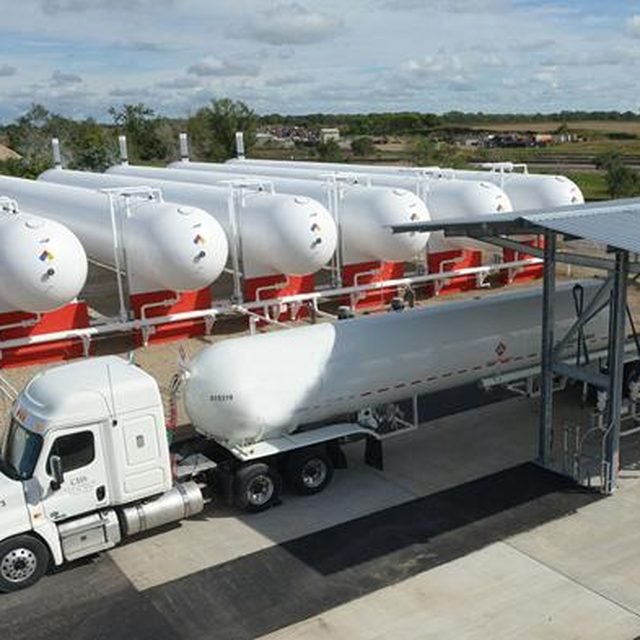
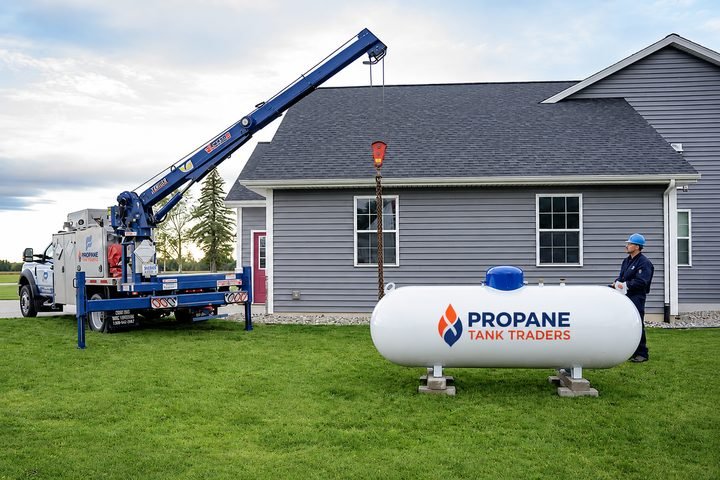
Two different trucks matter here. The first is the delivery truck that brings your tank – for anything in the 500 gallon class and up, that is a flatbed with a crane or a dedicated tank truck, and it needs a firm surface, adequate turning radius, and overhead clearance free of limbs and power lines. The second is the bobtail that will fill the tank for the rest of its service life.
Before you order, confirm the following:
- The approach road and driveway can carry a loaded heavy truck without rutting or collapsing a culvert.
- Overhead clearance along the full route, including tree canopy and utility drops.
- The tank location is within reasonable hose reach of where the bobtail can safely park. If it is not, every fill becomes a problem.
- Soft ground, recent rain, and steep grades – a crane truck needs level, stable footing to set outriggers.
- Gates, low walls, and landscaping that would need to come out temporarily.
We ship nationwide with flat $350 freight per order within the contiguous U.S. and typical transit of 3 to 10 business days depending on size and destination, with Alaska and Hawaii quoted separately. Freight delivers the tank to your site; it does not include setting, connecting, or filling it. Full details are on our shipping policy page.
Preparing the Base: Pad Work and Excavation
Above ground tanks
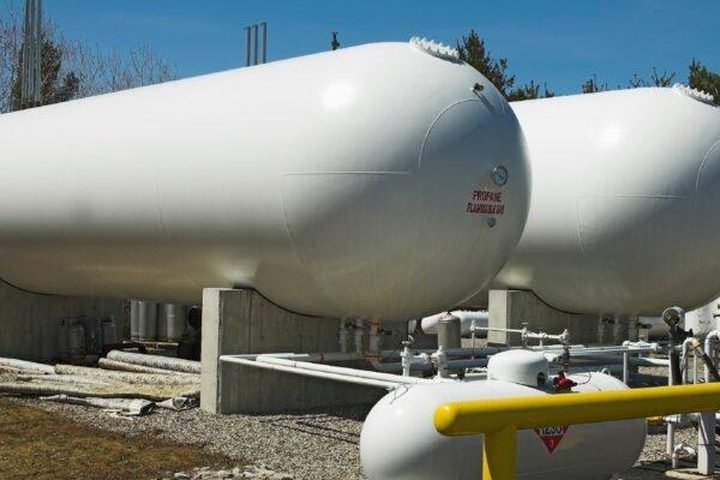
An above ground ASME tank sits on its own welded legs or saddles and needs a base that is level, stable, and will not settle unevenly. A reinforced concrete pad is the most common approved solution; compacted crushed stone or precast piers are accepted in some jurisdictions and by some suppliers. Confirm what your installer and AHJ will accept before you pour anything.
Aim for a pad that extends past the tank footprint on all sides, sits slightly above surrounding grade so water drains away, and is genuinely level – a tank leaning off plumb throws off the fixed liquid level gauge and stresses the piping connection. Let concrete cure fully before the set date.
Underground tanks
Underground propane tank installations are more involved and are where careful prep pays off most. The excavation must be sized to leave working clearance around the tank, with a bedding layer of clean sand or approved non-corrosive fill so the tank is not resting on rock or debris that would damage the coating.
NFPA 58 requires a minimum depth of earth cover over the container, with additional protection where vehicles may pass overhead. The tank’s factory coating must be inspected for holidays and repaired before backfill, and the sacrificial anode bag that provides cathodic protection has to be placed and connected correctly – this is what keeps the vessel from corroding. In a high water table, the tank also needs anchoring against buoyancy, typically to a concrete deadman or slab with straps.
Only the dome riser, the valves, and the gauge remain accessible at grade. Plan the surrounding landscaping so that dome stays reachable and does not become a low spot that fills with water.
How to Install a Propane Tank: What the Licensed Installer Does
Once the site is ready, the professional portion of the propane tank installation follows a predictable sequence. You should expect all of these steps, and you should expect documentation of the test results.
- Verify the site. The installer re-measures separation distances and confirms the base or excavation meets code and manufacturer requirements before anything is set.
- Set the container. The tank is placed on the pad or lowered into the excavation, leveled, and anchored where required. Underground tanks are backfilled in lifts with approved material.
- Install the regulator train. First-stage and second-stage regulators, or an integral two-stage unit, are selected for the system’s total BTU load and vent-terminated correctly.
- Run and support the gas piping. Underground service line, riser, tracer wire where applicable, sediment trap, and appliance shutoffs, all sized for the load and the run length.
- Pressure and leak test. The system is tested and held at the required pressure for the required duration, with the results recorded.
- Purge the container and lines. New tanks contain air and moisture that must be purged with propane vapor before the first fill, or the system will not operate correctly.
- First fill and appliance startup. The tank is filled to a maximum of 80 percent liquid capacity to allow for thermal expansion. Each appliance is lit, checked for correct combustion, and adjusted.
- Walk you through the system. Location and operation of the main service valve, how to read the gauge, and what to do if you smell gas.
Inspection, Sign-Off, and Post-Install Checks
The AHJ inspection on a propane tank installation usually happens before backfill on underground jobs and before the system is placed in service on any job. Do not let an installer backfill an excavation before the inspector has seen it – uncovering it again is expensive and entirely avoidable.
Keep a folder with the permit, the inspection sign-off, the pressure test record, the tank’s ASME data plate information and serial number, the regulator model, and the installer’s license number. This packet matters when you sell the property, when you switch propane suppliers, and if you ever file an insurance claim.
In the first weeks after commissioning, check that the dome or tank area drains properly after rain, that nothing has settled or shifted, and that vegetation and stored items stay clear of the tank and its relief valve. Then schedule a professional leak check and system inspection on a regular interval – our propane tank safety guide covers the ongoing routine, and PERC publishes plain-language consumer safety material worth reading once as a household.
The Bottom Line
Learning how to install a propane tank is really about learning where your responsibility ends. You choose a compliant site, secure the permits, get the truck in, and build a proper base. A licensed professional sets, connects, tests, purges, and fills. That division is not optional in most jurisdictions, and it is the reason propane systems have the safety record they do.
Current listed pricing on our store runs roughly $741 to $1,450 for a 120 gallon tank, $650 used to $2,350 new for a 250 gallon, and $820 used to $2,420 for a 500 gallon including new underground models, with freight billed separately at the flat $350 rate. Installation labor, excavation, concrete, and permits are local costs quoted by your installer and are not included.
If you are still deciding on capacity, configuration, or whether to buy at all, start with the buyer’s guide or browse the full tank lineup. Questions about a specific site or freight to a difficult address are welcome at (501) 218-9328 or through our contact page.