Sizing a propane tank is arithmetic, not guesswork: add up your appliance BTU ratings, divide annual BTU by 91,500 to get gallons per year, then remember tanks fill to only 80 percent of capacity, so a 500 gallon tank holds about 400. Most homes heating with propane land on a 500 gallon tank in moderate climates and 1,000 gallons in cold ones. Add margin for a standby generator, and check NFPA 58 setbacks before you pick a location.
What size propane tank do I need is the single most common question we field from buyers, and the honest answer is that it depends on arithmetic rather than intuition. Tank sizing is a math problem with three inputs: how much fuel your appliances burn, how cold your winters get, and how often you are willing to accept a delivery.
Guess low and you run dry in a January cold snap. Guess high and you tie up money in steel you will never fill to capacity, and you may struggle to turn over the fuel before it sits for years.
This guide walks through the calculation the way a supplier does it, then maps the results onto real tank sizes you can actually buy. If you want to skip ahead to hardware, our full range is on the tank shop page.
Start with BTU load, not square footage
Contractors sometimes size tanks off house square footage. That is a shortcut, and it breaks the moment a house has an oversized furnace, a pool heater, or a standby generator. The defensible method starts with the appliances themselves.
Every gas appliance carries a nameplate input rating in BTU per hour. A propane furnace might be rated at 100,000 BTU/hr. A tankless water heater can hit 199,000 BTU/hr at full fire. A kitchen range with five burners and an oven is typically 60,000 to 70,000 BTU/hr combined.
One gallon of liquid propane contains roughly 91,500 BTU. That conversion is the hinge of the whole calculation: total annual BTU divided by 91,500 gives you gallons per year.
Typical appliance input ratings
- Central furnace: 60,000 to 200,000 BTU/hr depending on house size
- Tank water heater: 30,000 to 40,000 BTU/hr
- Tankless water heater: 120,000 to 199,000 BTU/hr
- Kitchen range: 60,000 to 70,000 BTU/hr
- Clothes dryer: 30,000 to 35,000 BTU/hr
- Gas fireplace: 25,000 to 40,000 BTU/hr
- Standby generator: 1.5 to 3.5 gallons per hour under load
Nameplate ratings describe full fire, not average draw. Nothing runs at 100 percent duty cycle, which is why the next step matters more than the ratings themselves.
A worked example: estimating gallons per year
Take a 2,400 square foot house in a cold northern climate with four gas appliances. Here is how the estimate comes together.
Furnace. 100,000 BTU/hr, running an average of six hours a day across a 150-day heating season. That is 100,000 x 6 x 150 = 90,000,000 BTU, or about 983 gallons.
Water heater. 40,000 BTU/hr, roughly 1.5 hours of burner time a day, year-round. That is 40,000 x 1.5 x 365 = 21,900,000 BTU, or about 239 gallons.
Range. Averaging 30,000 BTU/hr for about an hour a day gives 10,950,000 BTU, or roughly 120 gallons.
Dryer. 35,000 BTU/hr for five hours a week is 9,100,000 BTU, or about 99 gallons.
Total: approximately 1,441 gallons per year. Heating is 68 percent of it, which is the usual pattern. In a mild southern climate that same house might burn 500 to 700 gallons, because the furnace line shrinks dramatically while the other three barely move.
Run this calculation with your own appliance nameplates before you shop. It takes ten minutes and it is the difference between a sized tank and a guessed one.
What size propane tank do I need for my household?
Once you have an annual gallon figure, convert it into a tank size using two adjustments: the 80 percent fill rule and your tolerance for deliveries.
Propane is stored as a liquid under pressure, and liquid propane expands significantly as it warms. Filling to the top would leave no vapor space for that expansion, so tanks are filled to 80 percent of water capacity. A nominal 500 gallon tank holds about 400 usable gallons. A 1,000 gallon tank holds roughly 800. This is not a supplier convention you can negotiate around; it is a safety requirement rooted in NFPA 58, the Liquefied Petroleum Gas Code.
The second adjustment is delivery frequency. Most propane dealers set a delivery minimum, commonly in the 150 to 200 gallon range, because a truck roll costs the same whether it drops 100 gallons or 400. If your tank cannot accept at least that minimum on a routine fill, you will pay a premium or be refused service.
A workable rule for whole-home heating: size the tank so that a full fill carries you through the coldest 60 days of the year without a delivery. Our example house burning 983 heating gallons over 150 days averages 6.6 gallons a day, but the coldest stretch will run closer to 10. Sixty days at 10 gallons is 600 gallons, which points at a 1,000 gallon tank rather than a 500.
Sizing by use case
Most buyers fall into one of a handful of profiles. Here is what each one typically lands on.
Grill, RV, and portable use
These are DOT cylinders, not ASME stationary tanks, and they are governed by 49 CFR Part 180 for requalification. A 20 lb cylinder handles a grill. A 100 lb (24 gallon) cylinder handles a construction heater, a small cabin, or a fish house. If you are unclear on the distinction, our breakdown of ASME versus DOT tanks covers which certification applies where.
Single appliance or seasonal supplemental heat
A 120 gallon (420 lb) vertical tank is the standard choice for a gas fireplace, a range plus dryer combination, or a small standby generator. It fits on a slab against the house and requires no excavation.
Partial home service
250 and 320 to 330 gallon tanks cover homes where propane runs cooking, hot water, and a dryer but not the primary heat source. They also suit vacation cabins that sit empty for months.
Whole-home heating
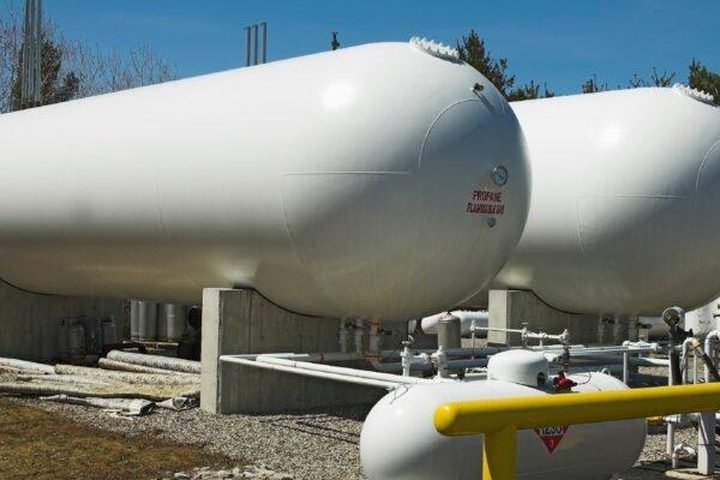
500 gallon tanks are the most common residential choice in the U.S. and cover most heating loads in moderate climates. In cold northern zones, or where a large generator shares the tank, 1,000 gallons is the safer call.
Farm, fleet, and commercial
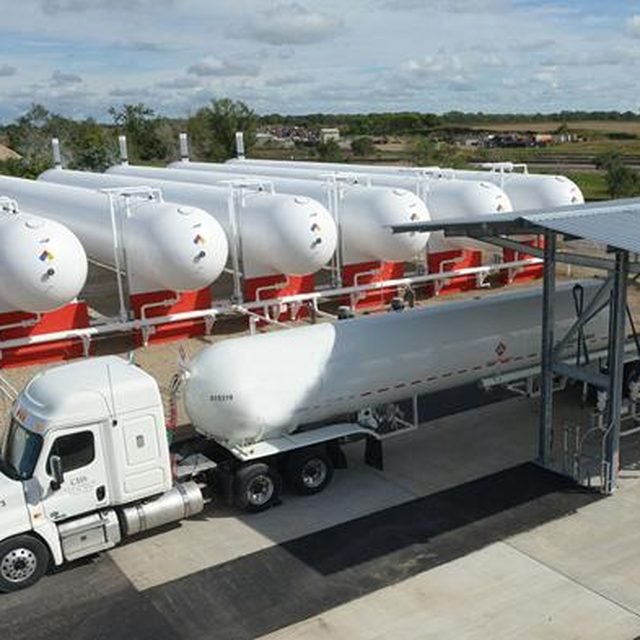
Grain drying, greenhouse heat, forklift fleets, and poultry barns push past what a residential tank can do. 1,000 to 2,500 gallons is typical, with 10,000 gallon and larger skid or bullet tanks serving bulk plants and industrial process heat.
Tank sizing table
| Tank size (nominal) | Usable at 80% | Typical use case | Approx. footprint |
|---|---|---|---|
| 100 lb cylinder | ~19 gal | Grill, cabin, temporary heat | 14 in dia x 48 in |
| 120 gal (420 lb) | ~96 gal | Fireplace, range, dryer, small generator | 30 in dia x 54 in |
| 250 gal | ~200 gal | Cooking, hot water, dryer; seasonal cabin | 30 in dia x 92 in |
| 320-330 gal | ~256-264 gal | Partial home service, mild-climate heat | 30 in dia x 119 in |
| 500 gal | ~400 gal | Whole-home heat, moderate climate | 37 in dia x 120 in |
| 1,000 gal | ~800 gal | Cold-climate whole home, home + generator, small farm | 41 in dia x 191 in |
| 1,500-2,000 gal | ~1,200-1,600 gal | Farm, greenhouse, light commercial | 46 in dia x 230-290 in |
| 2,500-10,000 gal | ~2,000-8,000 gal | Industrial process heat, fleet fueling | Site-specific |
| 18,000-30,000 gal | ~14,400-24,000 gal | Bulk plant, skid or bullet installation | Site-specific |
Footprints are representative and vary by manufacturer. We source from Quality Steel Corp, Manchester Tank, and Newberry, and exact dimensions are listed on each product page.
What size propane tank do I need if I go underground?
Burying a tank does not change the fuel math, but it changes three practical things.
First, underground tanks are somewhat more thermally stable. Soil buffers the tank against extreme cold, which helps maintain vapor pressure in northern winters. An above-ground 500 gallon tank in sustained sub-zero weather can struggle to vaporize propane fast enough for a large furnace; buried, it is less of a concern.
Second, the cost of getting a tank in the ground is largely fixed regardless of size. Excavation, the anode bag for cathodic protection, backfill, and the riser cost about the same for a 500 as for a 1,000. That economics usually argues for going one size up if you are burying anyway.
Third, you cannot easily change your mind. Swapping an above-ground tank is a crane and a truck. Swapping a buried tank is a full excavation. Size for the load you expect in ten years, not the one you have today. Our comparison of above ground versus underground tanks goes deeper on the tradeoffs.
Common sizing mistakes
- Forgetting the generator. A 22 kW standby unit under load burns roughly 3 gallons an hour. A three-day outage is 216 gallons, which will empty a 250 gallon tank and put a serious dent in a 500.
- Sizing off the last owner’s usage. Their thermostat habits, insulation upgrades, and appliance set are not yours.
- Ignoring vaporization rate. Tank surface area and ambient temperature limit how fast liquid propane becomes vapor. A tank can be full and still fail to feed a high-demand appliance in deep cold.
- Under-sizing to save on freight. Shipping is a flat $350 per order within the contiguous U.S. regardless of tank size, so the incremental cost of a larger tank is the tank itself.
- Skipping the setback check. NFPA 58 sets minimum distances from buildings, property lines, and ignition sources, and those distances grow with tank capacity. A 1,000 gallon tank may not fit a lot where a 500 does.
Before you order
Confirm three things: the setback distances your authority having jurisdiction enforces, whether your local dealer will fill a customer-owned tank, and what your delivery minimum is. Those answers can move you a size in either direction.
Installation of stationary propane tanks and any gas piping is licensed work in nearly every jurisdiction. We ship tanks; connecting and commissioning one is a job for a licensed propane professional, and permits are frequently required. PERC publishes plain-language consumer guidance worth reading before you commit to a location.
Delivery runs 3 to 10 business days depending on size and destination, and we ship to all 50 states, with Alaska and Hawaii quoted separately. Details are in our shipping policy.
The bottom line
What size propane tank do I need comes down to your annual gallon load, the 80 percent fill rule, and how long you want a full tank to last in the worst weather you get. For most homes heating with propane, that lands on a 500 gallon tank in moderate climates and a 1,000 gallon tank in cold ones.
Do the BTU arithmetic with your own appliance nameplates rather than a square-footage rule of thumb, and add margin for a generator if you have one. If you want a second set of eyes on the numbers, our buyer’s guide and FAQ page cover the recurring questions, or reach us at (501) 218-9328 or sales@propanetanktraders.com.