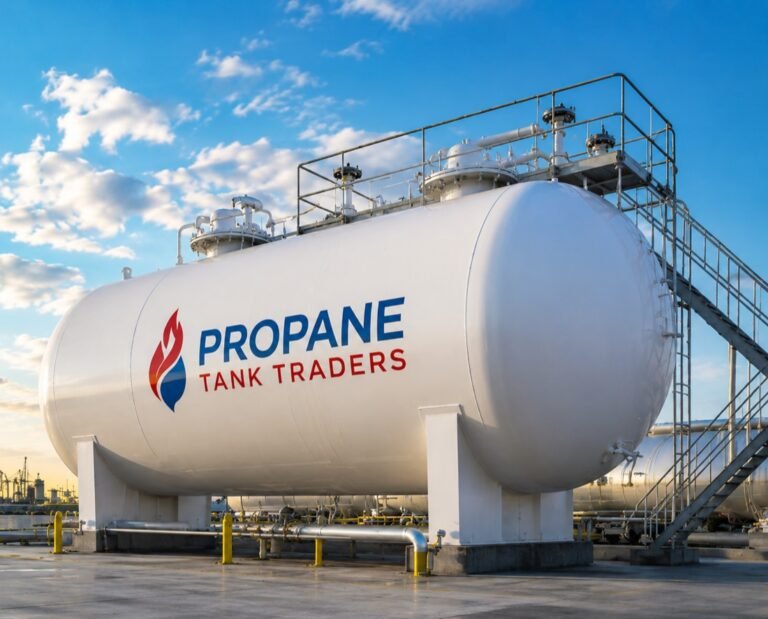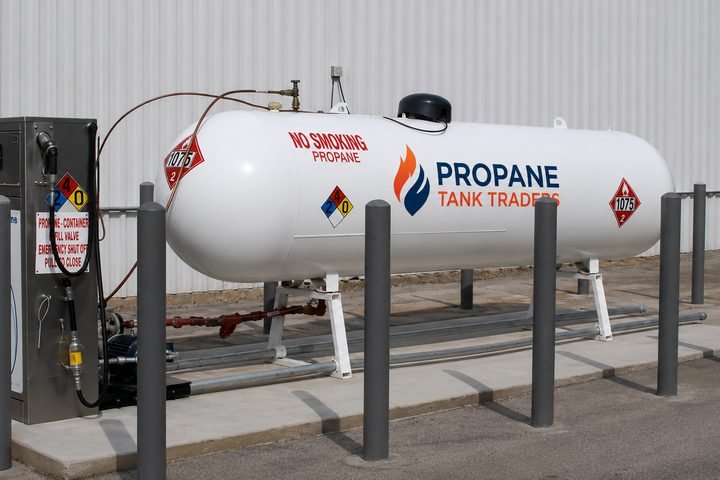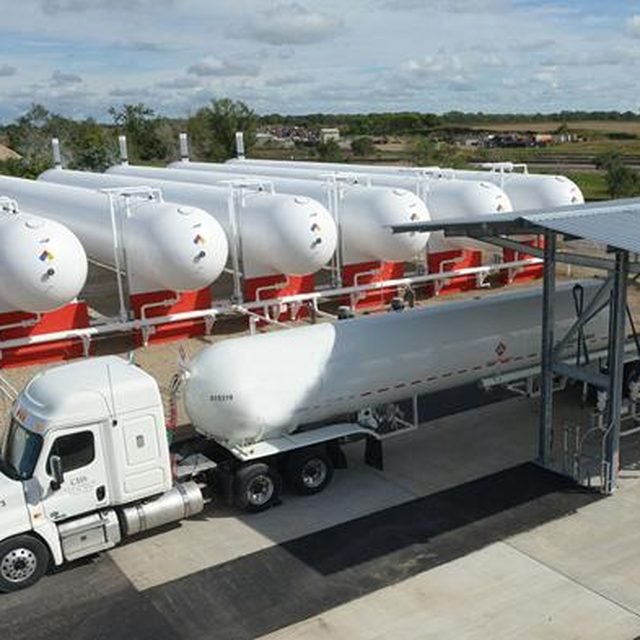
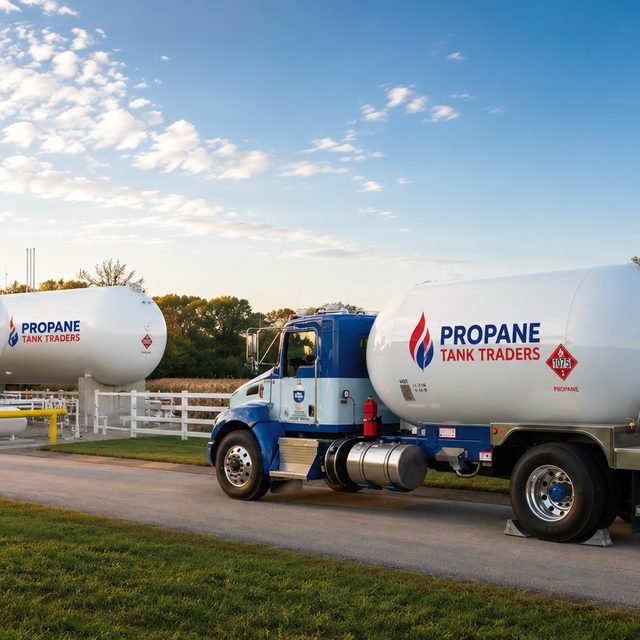
ASME tanks are built to the ASME Boiler & Pressure Vessel Code, Section VIII for permanent installation, and a bulk truck fills them where they sit. DOT cylinders are built under 49 CFR Part 178 to be transported to a filling station, and 49 CFR Part 180 requires requalification 12 years after manufacture, then every 5, 7, or 12 years depending on the method used. ASME tanks have no federal requalification interval. Choose ASME for home heating, generators, and commercial loads; DOT for grills, forklifts, and towable RVs.
The difference between ASME vs DOT propane tanks comes down to two separate rulebooks written for two very different jobs: one governs permanently installed vessels that a bulk truck fills where they sit, and the other governs portable cylinders that travel to a filling station and back. Both are pressure vessels holding the same fuel. They are not interchangeable, and picking the wrong one usually means a filler legally refuses to service it.
This is the question we field most often from first-time buyers, and it is worth getting right before you spend money. A cylinder you cannot get requalified is scrap metal. A stationary tank installed where a portable cylinder belongs is an expensive, immovable mistake.
Below is what each standard actually governs, how the two behave in practice, and which one fits the common scenarios: home heating, forklifts, RVs, grills, generators, and commercial use.
ASME vs DOT Propane Tanks: What Each Standard Actually Governs
The ASME Boiler & Pressure Vessel Code, Section VIII is the construction standard for stationary pressure vessels. It sets the design rules, material requirements, welding qualifications, and third-party inspection that a tank must satisfy before it can be stamped and put into service. Propane tanks built to Section VIII, Division 1 are typically rated for a 250 psig design pressure. You can read more about the code program at ASME.
The DOT side is federal transportation law. 49 CFR Part 178 contains the manufacturing specifications for portable cylinders — the specs you will see stamped on a propane cylinder collar are usually DOT-4BA240 or DOT-4BW240, where 240 is the service pressure in psi. 49 CFR Part 180, Subpart C then governs requalification: how often a cylinder must be re-inspected or re-tested to stay legal to fill. The current text of both parts is public at the eCFR.
The distinction is not about quality. It is about jurisdiction. DOT regulates containers that move on public roads with product inside them. ASME governs vessels that are installed once and stay put, with the fuel brought to them.
Where NFPA 58 fits
Neither standard tells you where to put the tank. That is NFPA 58, the Liquefied Petroleum Gas Code, which sets separation distances from buildings, property lines, and sources of ignition, along with installation and filling requirements. NFPA 58 applies to both tank types, and your local authority having jurisdiction (AHJ) adopts and enforces it, sometimes with amendments. More on the code at NFPA.
The Practical Differences You Will Actually Notice
Strip away the code language and four differences drive every real decision.
Stationary versus portable. An ASME tank is set on a pad or pier, plumbed to a regulator and a fixed gas line, and left alone. A DOT cylinder is designed to be disconnected, carried, and transported. That single fact cascades into everything else.
How it gets filled. An ASME tank is filled on site by a delivery truck, by volume, to a maximum of 80 percent using the fixed liquid level gauge — the little bleeder valve that spits liquid when the tank is full. A DOT cylinder goes to a filling station or exchange cage and is filled by weight, using the tare weight (marked “TW”) stamped on the collar. Filling a cylinder by anything other than weight or an accurate scale-verified method is how overfills happen.
The markings. ASME tanks carry a permanent nameplate or data plate showing the manufacturer, design pressure, water capacity, year built, and the ASME code stamp. DOT cylinders carry the specification, serial number, tare weight, original test date, and a growing series of requalification stamps around the collar.
Recertification. This is the biggest practical gap, and it deserves its own section.
Recertification: The Rule That Catches People Out
DOT cylinders expire. ASME tanks, at the federal level, do not.
Under 49 CFR Part 180, a propane cylinder must be requalified within 12 years of its manufacture date. After that first requalification, the interval depends on the method used:
- External visual inspection — requalified every 5 years, marked with an “E” after the date.
- Proof pressure test — requalified every 7 years, marked with an “S”.
- Volumetric expansion (hydrostatic) test — requalified every 12 years.
If the stamped date has lapsed, a filling station is not permitted to fill the cylinder. That is not a policy preference; it is federal law backed by NFPA 58 filling provisions. Requalification typically costs less than a new small cylinder, but for 20 lb grill bottles most people simply exchange or replace them.
ASME stationary tanks have no federal requalification interval. There is no expiration stamp and no mandatory hydrostatic retest schedule for a tank in normal LP-gas service. That does not mean “install it and forget it.” The tank still needs periodic inspection of the relief valve, gauges, paint and corrosion condition, and piping, and your supplier may refuse to fill a tank in visibly poor condition. Some states and AHJs impose their own inspection expectations. We cover expected service life in more detail in our guide to how long propane tanks last.
ASME vs DOT Propane Tanks Side by Side
| Factor | ASME tank | DOT cylinder |
|---|---|---|
| Governing standard | ASME BPVC Section VIII, Div. 1 | 49 CFR Part 178 (build), Part 180 (requalification) |
| Intended use | Permanently installed, stationary | Portable, transported with product |
| Typical design/service pressure | 250 psig | 240 psi (4BA240 / 4BW240) |
| How it is filled | On site by bulk truck, by volume to 80% | At a filling station, by weight |
| Recertification | No federal interval | 12 years, then 5 / 7 / 12 years by method |
| Identification | Permanent nameplate with code stamp | Collar stamps plus requalification dates |
| Common sizes | 120, 250, 320, 500, 1,000+ gallons | 20, 30, 40, 100 lb (24 gal), 420 lb |
| Orientation | Horizontal or vertical, fixed | Vertical (most), horizontal for forklifts |
| Moving it | Requires purge and professional relocation | Designed to be disconnected and carried |
Typical Sizes and What They Cost
DOT cylinders top out well below where ASME tanks begin to make sense. Portable cylinders are capped by their water capacity, which is why you see them from 20 lb grill bottles up through 100 lb (about 24 gallons) and 420 lb units. ASME tanks start around 120 gallons and run to bulk storage in the tens of thousands of gallons.
Current listed pricing across our catalog gives a sense of the ranges. Freight is separate at a flat $350 per order within the contiguous U.S.
| Tank | Type | Listed price range |
|---|---|---|
| 100 lb / 24 gal cylinder | DOT | $199 – $766 |
| 200 lb / 45.6 gal | DOT | $650 – $1,400 |
| 120 gal (420 lb) | ASME or DOT, check nameplate | $741 – $1,450 |
| 250 gal | ASME | $650 used – $2,350 new |
| 320 – 330 gal | ASME | $1,092 – $2,950 |
| 500 gal | ASME | $820 used – $2,420 new underground |
| 1,000 gal | ASME | $950 scrapped – $5,300 new underground |
| 2,000 gal | ASME | ~$3,705 |
| 10,000 gal | ASME | ~$13,300 |
The 120-gallon class is the one crossover point worth flagging. A 420 lb unit can be built to either standard depending on the manufacturer and intended service, so read the nameplate rather than assuming. If you are still narrowing capacity, start with our guide on what size propane tank you need, then browse the full tank catalog.
Valves and Fittings Are Not Interchangeable
The two tank families use different valve sets, and that is a deliberate safety boundary.
A DOT cylinder in 4 to 40 lb propane service must have an overfill prevention device (OPD) — the triangular handwheel you see on modern grill bottles — along with a service valve and integral relief valve. Forklift cylinders are a specific exception: they use a liquid withdrawal dip tube, mount horizontally with an alignment pin, and are not subject to the OPD requirement in the same way.
An ASME tank carries a fuller set of fittings on a multivalve or separate ports: a filler valve for the truck, a vapor service valve feeding the regulator, a pressure relief valve sized to the vessel, a fixed liquid level (bleeder) gauge, and usually a float gauge. Larger tanks add a vapor return and sometimes a liquid withdrawal port.
Do not adapt fittings between the two. Regulator selection, relief valve sizing, and connection type all follow the vessel, and this is work for a licensed gas professional — not a homeowner project.
Which One You Need, By Scenario
- Whole-home heating. ASME, essentially always. A 250 or 500 gallon tank is the common residential choice, with 500 gallons being the workhorse for a house heated primarily with propane.
- Grill or patio heater. DOT, 20 lb. Exchange or refill; requalification is rarely worth it at that size.
- Forklift and industrial trucks. DOT cylinders in the 33 lb class, horizontally mounted with liquid withdrawal. ASME forklift tanks exist for some equipment — match the truck’s spec.
- RV. Motorhomes typically use a permanently mounted ASME tank. Travel trailers and fifth wheels use removable DOT cylinders, usually 20 or 30 lb.
- Standby generator. ASME, sized to runtime. Generators burn fuel fast, and a cylinder-fed generator will not carry an outage.
- Commercial and agricultural. ASME, 1,000 gallons and up, often multiple tanks. Bulk and skid units run to 18,000 – 30,000 gallons in the $28,000 – $35,000 range.
Placement for any stationary tank is governed by NFPA 58 separation distances and must be approved by your local AHJ. If you are weighing burial, see above ground vs underground propane tanks.
Choosing Wrong: Legal and Filling Consequences
The failure modes are predictable.
Buy a DOT cylinder for a load that needs an ASME tank and you get chronic refills, possible vapor-draw shortfalls in cold weather, and a cylinder that eventually goes out of date. Buy an ASME tank and try to transport it full and you are outside DOT rules — ASME vessels are not authorized as shipping containers for propane on public roads.
The most common real-world consequence is simpler: a filler looks at an expired collar stamp and declines. Under NFPA 58 and 49 CFR Part 180 they have no discretion. Consumer safety guidance on handling and filling is published by the Propane Education & Research Council (PERC).
We ship to all 50 states, typically 3 – 10 business days depending on size and location. Returns run 30 days, with a 15% restocking fee on non-defective returns of tanks 500 gallons and above — details on the return policy page. If you are unsure which standard your application calls for, reach us directly at (501) 218-9328.
The Bottom Line
ASME vs DOT propane tanks is not a quality comparison — it is a use-case comparison. If the tank stays put and a truck comes to it, you need ASME. If the tank travels to the fuel, you need DOT, and you need to watch the requalification date.
Confirm the standard on the nameplate or collar before you buy, size the vessel to your actual load rather than your budget, and have any stationary installation set and connected by a licensed professional with AHJ approval. Our buyer’s guide walks through the rest of the decision.