DOT portable propane cylinders run on a federal clock under 49 CFR Part 180: 12 years from the manufacture date stamped on the collar, then 5 years for an external visual requalification (marked E), about 7 for a proof pressure test (marked S), or 12 more for a volumetric expansion test. ASME stationary tanks have no federal requalification interval and commonly last 30 years or more above ground, or 20 to 30 underground with working cathodic protection. Corrosion, not age, retires most tanks.
How long do propane tanks last is a question with two very different answers, depending on whether you own a stationary ASME tank or a portable DOT cylinder. One is governed by maintenance and corrosion; the other is governed by federal law and a stamped expiration clock.
Confusing the two is the most common mistake we see when people ask how long propane tanks last. A homeowner hears “propane tanks expire after 12 years,” panics about the 500-gallon tank in the side yard, and calls asking to replace a vessel that has another two decades of service in it.
Here is the practical breakdown: what actually determines service life by tank type, how to read the markings that tell you where your tank stands, what kills tanks early, and when replacement is genuinely the right call.
How Long Do Propane Tanks Last by Type?
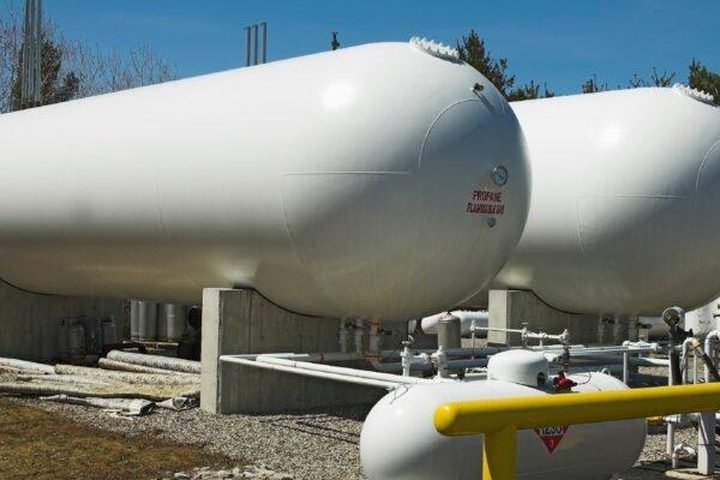
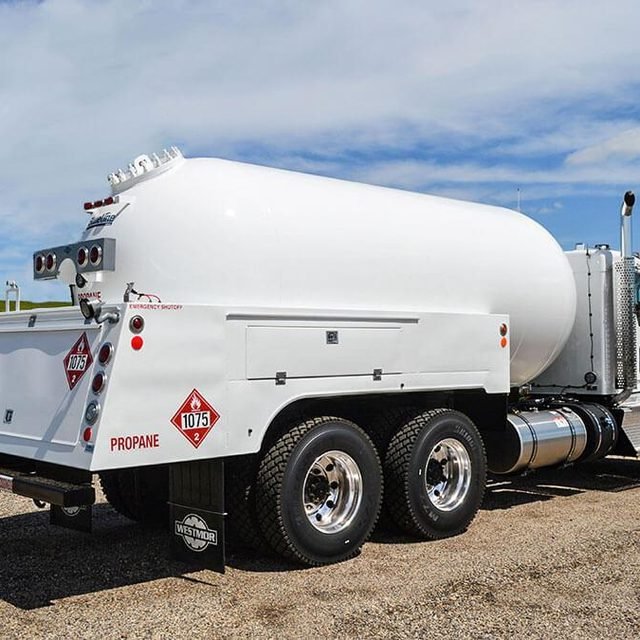
Propane tank lifespan splits along construction standard. Stationary tanks are built to the ASME Boiler & Pressure Vessel Code, Section VIII, which governs pressure vessel design, welding, and testing. Portable cylinders are built to U.S. Department of Transportation specifications, because they are legally treated as shipping containers that travel on public roads.
That legal distinction drives everything. DOT cylinders carry a federally mandated requalification schedule under 49 CFR Part 180. ASME stationary tanks do not have a federal requalification interval at all.
| Tank type | Standard | Typical service life | Requalification requirement |
|---|---|---|---|
| ASME stationary, above ground (120-1,000 gal) | ASME Section VIII | Commonly 30 years or more with maintenance | None federally mandated; inspect and maintain |
| ASME stationary, underground | ASME Section VIII | Roughly 20-30 years; longer with intact coating and working cathodic protection | None federally mandated; test cathodic protection periodically |
| DOT portable cylinder (20 lb – 100 lb) | DOT 4BA / 4BW | Indefinite if it keeps passing requalification | 12 years from manufacture, then 5, 7, or 12 years by method |
| ASME motor fuel / forklift tank | ASME Section VIII | Tied to vessel condition, not a clock | None federally mandated; valve and fitting service required |
Those service life figures are conditions-dependent, not warranties. A coastal tank in salt air and a tank in dry high desert will not age the same way. Nobody can promise you a number.
DOT Cylinders and the 12-Year Clock
If you own portable cylinders – a 20 lb grill bottle, a 100 lb cylinder feeding a cabin, a forklift bottle – the governing rule is 49 CFR Part 180, enforced by the Pipeline and Hazardous Materials Safety Administration. You can read the current text at the Electronic Code of Federal Regulations.
A new DOT propane cylinder is legally fillable for 12 years from its date of manufacture. After that, it must be requalified by a DOT-registered requalifier before anyone can legally refill it. This is not a suggestion a filling station can waive. A propane dealer who fills an out-of-date cylinder is the one breaking federal law, which is why they refuse.
How long a propane cylinder lasts is not capped at 12 years, though. The cylinder itself does not become garbage at that mark. It becomes a cylinder that needs inspection. Plenty of cylinders pass requalification repeatedly and stay in service for decades.
Reading the stamps on the collar
Look at the collar – the steel handle ring welded around the valve. The markings are stamped into it, and they are usually painted over and hard to read until you clean them off.
- Specification: something like DOT 4BA240 or DOT 4BW240. The number is the service pressure in psi.
- Manufacture date: a month-year pair such as 06 14, meaning June 2014. That date starts your 12-year clock.
- Requalification dates: additional month-year pairs stamped after the original, each with a method letter.
- TC or WC: tare weight (empty weight) and water capacity, used to determine correct fill volume.
Read the dates left to right and use the most recent one. If the newest stamp is 06 14 with no letter, that is the manufacture date and the cylinder expired in June 2026.
What the E and S letters mean
The letter stamped after a requalification date tells you which method the requalifier used, and the method determines how long the new interval runs.
- No letter (volumetric expansion test): the cylinder is filled with water and pressurized in a test jacket to measure permanent expansion. This is the most rigorous method and earns the longest interval – 12 years.
- E (external visual inspection): a trained inspector examines the cylinder exterior for corrosion, dents, gouges, fire damage, and bad welds under 49 CFR 180.209. Faster and cheaper, shorter interval – 5 years.
- S (proof pressure test): the cylinder is pressurized and checked for leakage and distortion without measuring expansion. Interval is commonly cited as 7 years.
So a cylinder stamped 03 21 E was requalified by external visual inspection in March 2021 and is fillable through March 2026. A cylinder stamped 03 21 with no letter is good through March 2033.
Verify intervals against the regulation itself or with your requalifier before acting on them, because Part 180 does get amended. If the markings are unreadable, the cylinder cannot be legally filled – period. There is no way to prove its age, so it goes to scrap. We cover the construction differences in more depth in our ASME vs. DOT tank comparison.
How Long Do Propane Tanks Last When They Are ASME Stationary Vessels?
Here is the part that surprises people: there is no federal requalification interval for ASME stationary propane tanks. No 12-year expiration, no mandatory hydrostatic retest, no stamp that goes stale. An ASME tank is built and stamped once, at the factory, under Section VIII rules. You can read about the code program at ASME.
That is not permission to ignore it. NFPA 58, the Liquefied Petroleum Gas Code, governs installation, separation distances, and continued safe operation, and it expects tanks to be maintained in serviceable condition. Your propane supplier will also inspect before filling and can refuse a tank they judge unsafe. Local codes and your authority having jurisdiction may impose their own inspection requirements. See NFPA for the code itself.
In practice, an above-ground ASME tank that stays painted, stays clear of standing water and vegetation, and gets its valves serviced will commonly run 30 years or more. What ends its life is almost always corrosion or damage, not age.
What Actually Kills Propane Tanks
After enough years shipping tanks nationwide, the failure patterns are repetitive. How long propane tanks last in the field is rarely a matter of age; tanks rarely die of old age. They die of these things.
- Corrosion under the foot ring. The single most common killer of above-ground tanks. Water and debris collect where the saddle or foot ring meets the shell, stay wet, and eat through from the outside. Because it is hidden under the mount, nobody sees it until it is advanced.
- Ground contact. A tank set directly on dirt, gravel, or a settling pad wicks moisture continuously. Tanks should sit on proper piers or a level concrete pad with drainage.
- Underground coating damage. Buried tanks depend on an intact factory coating. A shovel strike during backfill, a rock in the trench, or careless landscaping later creates a holiday in the coating, and corrosion concentrates there.
- Valve and fitting degradation. Relief valves, service valves, and gauges wear out long before the vessel does. Relief valves in particular are wear items that a licensed technician should evaluate.
- Physical damage. Vehicle strikes, falling limbs, a tank rolled or dropped during a botched move. Any dent, gouge, or dig in the shell needs professional evaluation before refill.
- Unreadable data plate. If the nameplate is corroded or painted over beyond legibility, many suppliers will refuse to fill the tank, because they cannot verify its specifications.
Reading an ASME data plate
ASME tanks carry a metal nameplate, usually near the dome or under the hood. It lists the manufacturer, the ASME code stamp, the National Board number, the year built, water capacity in gallons, working pressure in psi, and the design temperature range.
The year built is your age reference. Protect that plate – do not paint over it, do not sand it, and do not let it corrode. Suppliers we work with, including Quality Steel Corp, Manchester Tank, and Newberry, all stamp this information at the factory, and once it is gone it cannot be recreated.
Maintenance That Extends How Long Propane Tanks Last
Most of what extends propane tank lifespan is unglamorous and cheap relative to replacement.
Above-ground tanks
- Keep the paint intact. Touch up scratches and rust spots before they spread. Use a light reflective color – white, silver, or light gray. Dark paint raises internal pressure in summer sun, and NFPA 58 addresses this.
- Clear vegetation. Keep grass, brush, and vines off the tank and out from under it. Vegetation traps moisture against steel and blocks inspection.
- Check the base. Make sure water drains away rather than pooling around the foot ring, and that piers have not settled.
- Watch the dome. Keep the valve hood closed so rain does not sit on the fittings.
Underground tanks
Buried tanks need cathodic protection – sacrificial anode bags, usually magnesium, wired to the tank so they corrode instead of the steel. Anodes are consumable. They deplete, and when they do the tank starts corroding.
Cathodic protection is tested with a reference electrode that measures tank-to-soil potential. A qualified technician takes the reading; a protected steel tank should read at or beyond the industry threshold, and a weak reading means the anodes need replacement. Have this tested on a regular schedule rather than assuming it is fine, and never dig near a buried tank yourself. Our above-ground vs. underground comparison covers the tradeoffs in full.
Both types
Schedule periodic professional inspection through your propane supplier or a licensed gas technician. Regulator replacement, relief valve evaluation, leak checks, and connection tightening all require someone qualified. Consumer guidance from the Propane Education & Research Council at propane.com is a good baseline, and our safety tips guide goes further.
When to Retire or Replace a Tank
Replace rather than repair when any of the following is true. Pressure vessel repair is specialized work that requires code-qualified welders, and for most residential tanks the economics do not favor it.
- Pitting corrosion deep enough that a technician cannot verify remaining wall thickness
- Any dent, gouge, or crease in the shell or weld seams
- Fire damage, including scorched paint over a large area
- A data plate that can no longer be read
- An underground tank with confirmed coating failure or failed cathodic protection readings
- A DOT cylinder that fails requalification or has illegible collar stamps
Replacement is usually less painful than expected. Current listed pricing runs about $199 to $766 for a 100 lb cylinder, $741 to $1,450 for a 120-gallon tank, $650 used to $2,350 new for a 250-gallon, and $820 used to $2,420 for a 500-gallon underground unit. Larger 1,000-gallon vessels range from $950 scrapped to $5,300 new underground. Freight is separate at a flat $350 per order within the contiguous U.S., with Alaska and Hawaii quoted separately, and delivery typically runs 3-10 business days. Full breakdowns are in our cost guide and buyer’s guide.
The Bottom Line
How long do propane tanks last comes down to which clock applies to you. DOT cylinders run on a legal clock: 12 years from manufacture, then 5, 7, or 12 more depending on requalification method, with the stamp on the collar telling you where you stand. ASME stationary tanks run on a condition clock with no federal expiration, commonly reaching 30 years above ground and 20-30 underground when the coating and cathodic protection hold.
In both cases, corrosion is the enemy and maintenance is the lever. Paint, drainage, vegetation control, anode replacement, and periodic professional inspection do more for tank longevity than anything else available to you.
When it is genuinely time to replace, browse the current range in our tank shop or call us at (501) 218-9328 to talk through sizing and shipping. Anything involving connection, disconnection, or installation of a propane tank should go to a licensed gas professional and, where required, through your local authority having jurisdiction.