Above ground propane tanks cost less installed, are easy to inspect, and suit sites with flood risk or a high water table. Underground tanks cost more because of excavation, bedding, backfill, and cathodic protection, but they hold vapor pressure better in cold climates and need far less clearance under NFPA 58 in the 501 to 2,000 gallon range. Buried tanks require anode testing every few years. Either way, the AHJ approves placement and a licensed professional does the install.
Choosing above ground vs underground propane tank placement is one of the few decisions in a propane install you cannot cheaply reverse, so it is worth more than a glance at the yard. The tank itself is a modest part of the difference. Excavation, bedding, corrosion protection, and code-driven setbacks are what actually separate the two paths.
Both configurations use ASME stationary vessels built to the same code. What changes is the shell coating, the fittings arrangement, the separation distances your local code requires, and how the tank behaves in cold weather and in water.
Here is the honest comparison: cost, installation, NFPA 58 clearances, climate performance, flood risk, maintenance, and service life.
Above Ground vs Underground Propane Tank: The Cost Reality
An underground tank of the same capacity costs more than its above ground counterpart. The vessel carries a factory-applied protective coating, a sacrificial anode bag, and a dome or riser assembly that brings the valves up to grade. Those additions show up in the listed price.
Current listed pricing on our catalog, with the underground figures at the top of each range:
| Capacity | Listed price range | Notes |
|---|---|---|
| 250 gal | $650 used – $2,350 new | Above ground residential |
| 320 – 330 gal | $1,092 – $2,950 | Above ground residential |
| 500 gal | $820 used – $2,420 new underground | Most common residential size |
| 1,000 gal | $950 scrapped – $5,300 new underground | Large home, farm, light commercial |
| 1,500 gal | $2,600 – $2,950 | Commercial |
| 2,000 gal | ~$3,705 | Commercial |
| 2,500 gal | ~$6,100 | Commercial |
Freight is separate at a flat $350 per order within the contiguous U.S., with Alaska and Hawaii quoted individually. Delivery generally runs 3 – 10 business days depending on size and destination; the shipping policy has the specifics.
The larger gap is installation, not hardware. An above ground tank needs a level, stable base and a gas line run. An underground tank needs an excavator, engineered bedding, imported backfill, spoil removal, and often anchoring. That labor and equipment cost varies enormously by soil type, access, and region, which is why we do not quote a single national figure. Get bids locally. For a broader cost picture, see how much a propane tank costs.
What Installation Actually Involves
Above ground
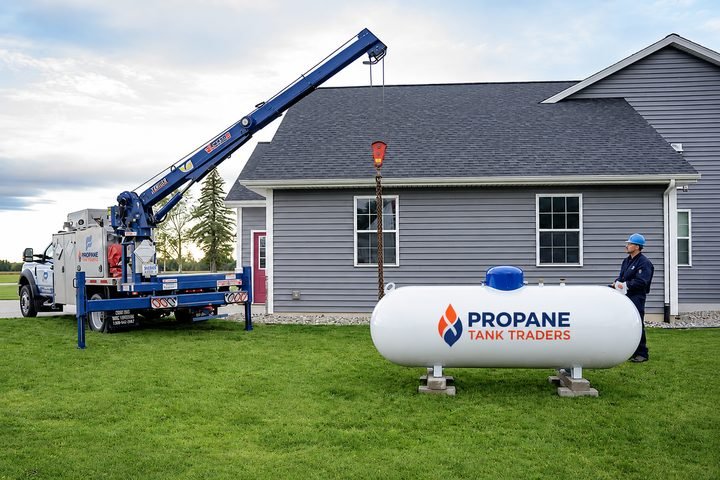
The tank sits on a firm, level pad — usually a poured concrete slab, precast piers, or a compacted base per the manufacturer’s instructions. The legs must bear evenly. From there it is regulator selection, a service line to the structure, pressure testing, and inspection.
In practice the above ground sequence is short:
- Confirm the placement against NFPA 58 clearances and get AHJ sign-off.
- Pour or set the pad, piers, or compacted base and let it cure.
- Set the tank level, with the legs bearing evenly.
- Install the regulator train and run the service line to the structure.
- Pressure test the piping, then have the system inspected and commissioned before first fill.
It is the simpler install by a wide margin, and it is the reason above ground remains the default across most of the country.
Underground
Burial is a real construction job, and every step matters to the tank’s survival:
- Excavation sized to leave working clearance around the vessel, at a depth that yields the required earth cover over the tank shell.
- Bedding of clean sand or fine, rock-free soil. A single sharp stone bearing on the coating is a future corrosion cell.
- Backfill with the same clean material, hand-placed against the tank before machine backfill above it.
- Cover per NFPA 58 — generally at least 6 inches of earth, or 4 inches of earth plus 4 inches of concrete or asphalt where vehicles may pass over.
- Riser and dome bringing the fill valve, service valve, relief valve, and gauges to an accessible point at grade, with a weather-resistant lid.
- Anode bag and cathodic protection — a sacrificial magnesium anode wired to the tank, buried alongside it, that corrodes preferentially so the steel does not.
- Anchoring where groundwater is a factor, typically hold-down straps to a concrete deadman or pad.
None of this is homeowner work. Setting, connecting, and commissioning a stationary propane tank requires a licensed gas professional, and the location must be approved by your local authority having jurisdiction (AHJ) before the hole is dug. Our overview of propane tank installation covers the sequence in more depth.
NFPA 58 Separation Distances Favor Burial
NFPA 58, the Liquefied Petroleum Gas Code, sets minimum distances between LP-gas containers, important buildings, and the line of adjoining property that may be built upon. This is where underground placement earns its keep on a tight lot. Code text and editions are available through NFPA.
| Container water capacity | Above ground: to building or property line | Underground: to building or property line |
|---|---|---|
| 125 gal or less | 0 ft (with opening/ignition-source limits) | 10 ft |
| 126 – 250 gal | 10 ft | 10 ft |
| 251 – 500 gal | 10 ft | 10 ft |
| 501 – 2,000 gal | 25 ft | 10 ft |
| 2,001 – 30,000 gal | 50 ft | 50 ft |
Read the 501 – 2,000 gallon row carefully. A 1,000 gallon above ground tank needs 25 feet of clearance; buried, the same vessel needs 10. On a suburban lot that difference frequently decides whether a large tank is placeable at all.
Separately, the filling connection and the fixed liquid level gauge must be kept a minimum distance — commonly 10 feet — from any external source of ignition, direct-vent appliance intake, or mechanical ventilation intake, regardless of tank type. Editions differ and many jurisdictions amend the adopted code, so treat this table as orientation, not as your permit. Your AHJ has the final word on placement.
Above Ground vs Underground Propane Tank Performance in Cold Weather
Propane delivers gas to your appliances as vapor, and vapor pressure falls with temperature. A tank has to stay warm enough to boil off liquid fast enough to meet demand. Below roughly 0 degrees F, an above ground tank’s vapor pressure drops sharply, and a partially full tank with a heavy heating load can struggle to keep up.
Buried tanks sit in soil that holds a far more stable temperature than the air above it. Through a cold snap, ground temperature at burial depth barely moves. That is a genuine functional advantage in northern climates, not just a talking point — it is why underground installs are more common the further north you go.
The same insulation works mildly in your favor in summer heat, keeping the vessel and its relief valve away from the temperature swings a sun-exposed above ground tank sees.
Flooding, Water Tables, and When Burial Is the Wrong Call
The underground advantages reverse in wet ground.
An empty or nearly empty buried tank is buoyant. In saturated soil or a flood event, an unanchored tank can float, break its connections, and surface — a serious hazard and a total loss. Proper anchoring to a concrete pad or deadman addresses this, but it adds cost and it has to be engineered for the site.
A high water table also accelerates corrosion and shortens anode life. If your property is in a mapped floodplain, has a seasonal high water table, or sits on heavy clay that holds water, above ground is very often the correct answer even where aesthetics argue otherwise. Say so to your installer before they price the job.
Consumer safety guidance on tank siting and severe weather is published by PERC.
Aesthetics, Access, and Property Value
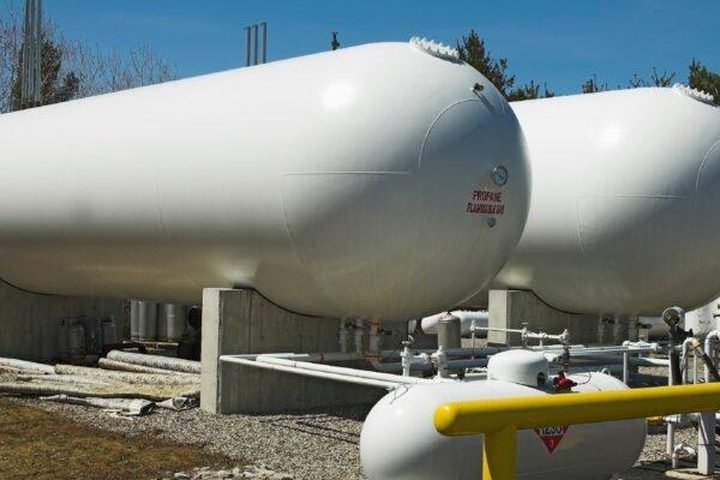
The visual argument is the reason most homeowners raise burial in the first place, and it is legitimate. A buried tank leaves only a small dome at grade. A 500 gallon above ground tank is roughly 10 feet long and cannot be hidden behind shrubs without violating clearance and access requirements — landscaping must not block the fill point or trap vapor.
Whether burial adds resale value is genuinely situational. On a landscaped property in a neighborhood where propane is standard, buyers notice. On rural acreage, nobody cares.
Access cuts the other way. Above ground, you can walk around the tank and see rust, dents, leaning legs, valve condition, and the gauge in ten seconds. Buried, you are inspecting through a small opening and relying on cathodic protection readings for the condition of steel you cannot see. Repairs and eventual replacement are also far more disruptive underground.
Corrosion Protection and Ongoing Maintenance
An above ground tank’s maintenance is mostly paint. Keep the shell coated in a light reflective color, address rust before it pits, keep the dome lid on, keep vegetation clear, and have the relief valve and regulator checked on the schedule your supplier recommends.
An underground tank depends on two things staying intact: the factory coating and the sacrificial anode. Under NFPA 58, cathodic protection systems are to be tested within the first 6 months after installation and at intervals thereafter — commonly every 3 years — with a qualified technician taking a structure-to-soil potential reading. If the reading indicates the anode is depleted, it gets replaced.
Anode service life depends heavily on soil resistivity, moisture, and stray current. In favorable soil an anode can last a couple of decades; in aggressive, wet, or high-salt soil it can go much faster. This is why the test interval matters more than any nominal replacement year. Skipping the readings is the single most common way a buried tank fails early.
Expected Service Life
A well-maintained above ground ASME tank is commonly expected to give 20 to 30 years of service, and many exceed that. Failure is usually corrosion at the legs, at the saddle contact points, or under chipped paint — all of it visible, all of it fixable if caught.
A buried tank with an intact coating and a maintained anode can match or beat that. A buried tank with a coating damaged during backfill, or with an anode nobody ever tested, can fail considerably sooner and without warning. Burial is not more durable by default; it is more durable when installed and monitored correctly.
Either way, size the tank to your real load first. Our guide on what size propane tank you need covers that, and the current inventory is in the shop.
The Bottom Line
Choose above ground if you want lower total installed cost, straightforward inspection, easier replacement, or if your site has a high water table, flood exposure, or poor drainage. Choose underground if lot clearances are tight for a larger tank, if you are in a cold climate where stable vapor pressure matters, or if the visual impact genuinely bothers you and the ground is dry and workable.
Whichever you pick, the placement has to be approved by your local AHJ and the installation performed by a licensed professional — there is no compliant DIY path here. We ship ASME tanks from Quality Steel Corp, Manchester Tank, and Newberry to all 50 states; the buyer’s guide covers specification, and you can reach us at (501) 218-9328 or through the contact page to talk through your site before you order.